
Thin, hard, and nearly impossible to stain.
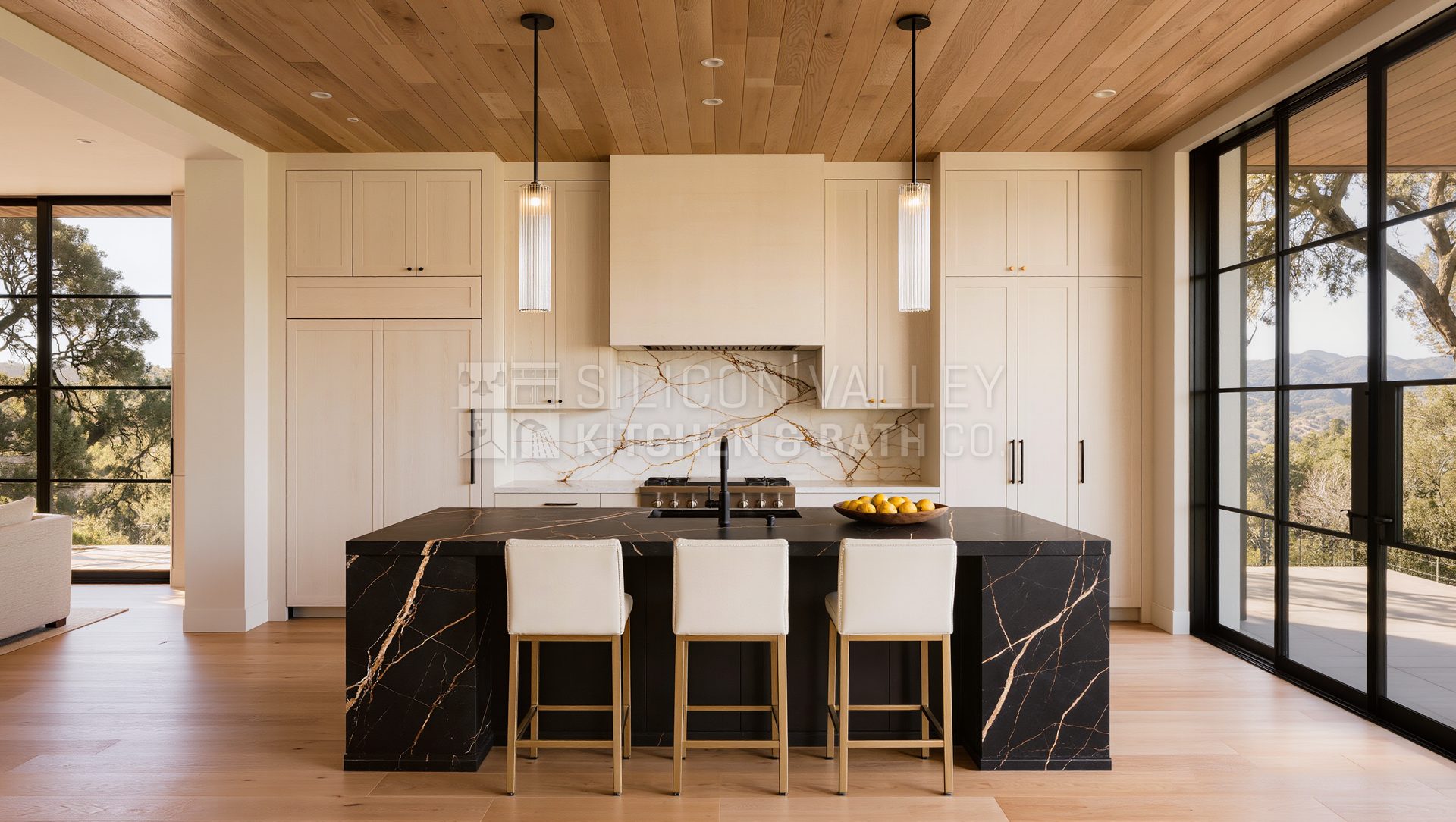
Silicon Valley Kitchen & Bath Co. designs and installs Dekton and porcelain slab countertops from our office in Campbell, serving the South Bay and the Bay Area. These are fired mineral slabs that resist heat, scratches, UV and stains far better than natural stone, and they reward careful fabrication: mitered edges, tight seams, and support planned for the thickness you choose. We also carry Silestone, Neolith, Xtone and Viatera, and we handle templating, fabrication and installation under one contract.
CSLB License #975092 · Licensed since 2012 · 2272 Camden Avenue, Campbell
What's included
- —Dekton, Neolith and Xtone sintered and porcelain slabs
- —Silestone and Viatera quartz as the other lines we carry
- —12 mm or 20 mm thickness, chosen for the edge and the span
- —Mitered waterfall and built-up edges
- —Seam placement planned with you on the drawing
- —Backsplash cut from the same slab
- —Support for overhangs and cooktop cutouts
- —Templating, fabrication and installation under one contract
What a sintered slab is
Dekton, Neolith and Xtone are made by pressing mineral powders under extreme pressure and firing them at very high temperature, which is close to how porcelain tile is made but at full-slab scale. The result is dense and non-porous, colored through the body or printed on the surface depending on the line. A hot pan can go straight onto it, lemon and wine do not etch it, and it does not yellow outdoors, which is why it is the material we put on outdoor kitchens. Quartz, like Silestone and Viatera, is resin-bound: easier to fabricate, less heat tolerant, and not for direct sun.
Thickness, edges and seams
Porcelain and sintered slabs come in 12 mm and 20 mm. The 20 mm slab makes a conventional edge with a simple polish and tolerates overhangs and cutouts more forgivingly. The 12 mm slab is lighter but shows a thin edge, so it is usually mitered: two pieces cut at 45 degrees and bonded to read as a thick slab, which demands a skilled shop. Seams are placed on the drawing before fabrication, away from the sink and cooktop corners where stress concentrates, and matched to the slab pattern so the join nearly disappears.
Why fabrication is the whole game
The material is only as good as the shop that cuts it. Sintered slabs are brittle until they are supported, so they crack at the inside corners of sink and cooktop cutouts if those corners are not radiused and relieved, and they chip at the edge if the blade and feed rate are wrong. Poor fabrication shows up as a seam you can feel, a miter with a visible glue line, or a cutout that fails a year later. We go through what to look for on a sample edge with you before the slab is cut, and the backsplash comes off the same slab so the pattern continues.
Questions we get
- Do you install Dekton and porcelain countertops in Campbell and the South Bay?
- Yes. Our office is at 2272 Camden Avenue in Campbell, and we install Dekton and porcelain slab countertops in Campbell, Los Gatos, Saratoga, San Jose, Cupertino and across the Bay Area as part of our design-build kitchen and bath remodeling. We hold California CSLB License #975092 and have been licensed since 2012.
- What is the difference between Dekton, porcelain slab and quartz?
- Dekton and Neolith are sintered stone and Xtone is a large-format porcelain; all three are fired mineral slabs that handle heat, UV and stains without sealing. Quartz such as Silestone and Viatera is ground stone bound with resin, so it is easier to cut and repair but can scorch under a hot pan and fade in direct sun.
- Should I choose 12 mm or 20 mm?
- If you want a thick edge or a waterfall, 20 mm is simpler and more robust. If you want a thin modern profile or are matching a slab backsplash, 12 mm works well with a mitered edge from a good shop. The spans, overhangs and cutouts in your layout decide; we go through them on the drawing.
- Can I put a hot pan on Dekton?
- Yes. Sintered stone takes direct heat from pots and pans without scorching, which quartz cannot. We still suggest a trivet under cast iron straight from the oven as a habit, since any slab can be shocked at a thin edge or near a cutout.
- Will the countertop have seams?
- Slabs are large, commonly around 126 by 56 inches or more depending on the line, so many kitchens need one or two seams. We place them on the drawing before fabrication, away from sink and cooktop corners, and align the pattern so they are hard to find.
Where we build
Based in Campbell and working from Napa to Carmel. These are the cities closest to our office.
- Campbell
- Los Gatos
- Saratoga
- San Jose
- Cupertino
- Monte Sereno
- Santa Clara
- Sunnyvale
- Los Altos
- Mountain View
- Palo Alto
- Menlo Park
From the Journal
- Porcelain and Sintered Stone Countertops: The Complete Guide
- Quartz vs. Dekton: Which Countertop Is Right for Your Kitchen?
- Countertop Fabrication: What Separates a Great Install from a Cheap One
- The Best Countertops for Bay Area Kitchens (2026)
Related specialties
Ready to build something that lasts?
One team handles design, permits, and build — from concept to finished space.